







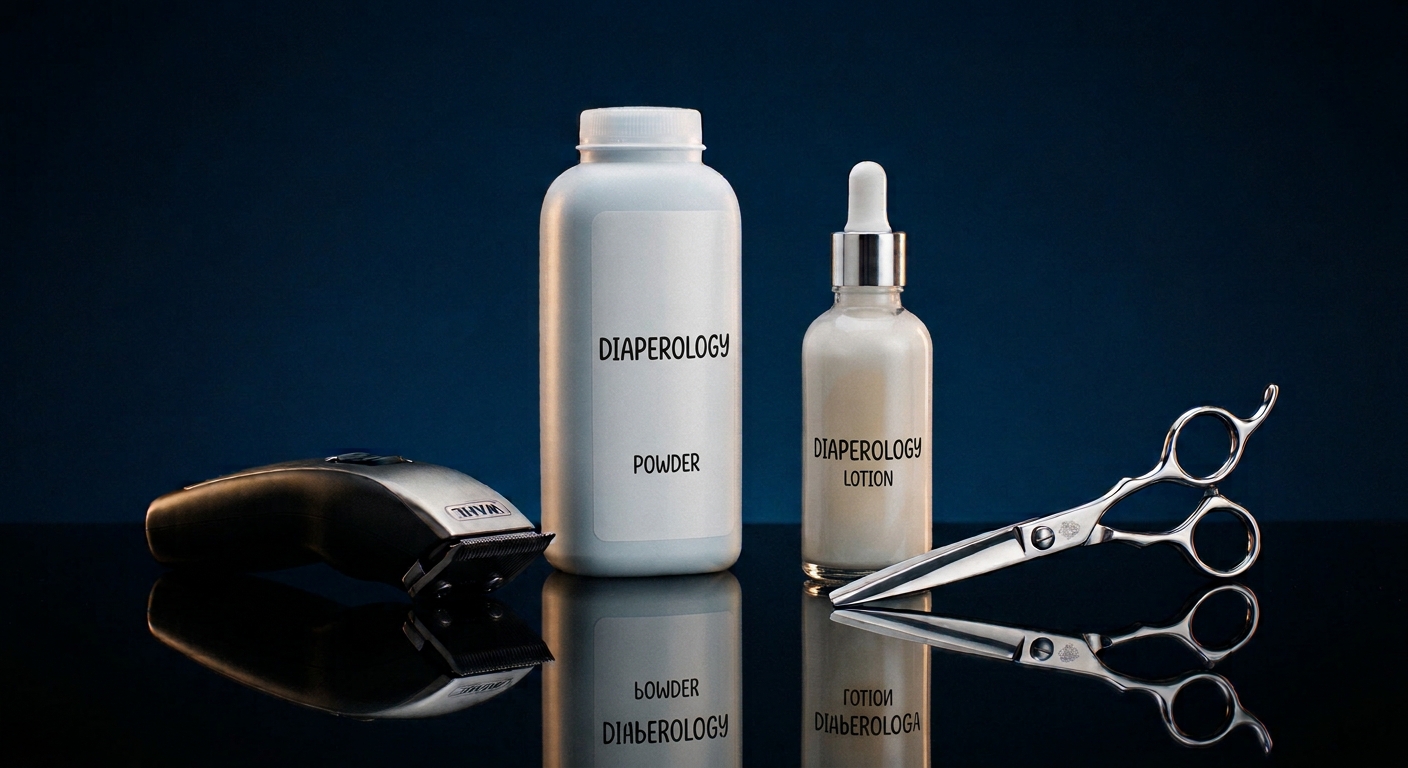
Featured image: generated with Nano Banana (Google Gemini).
There’s a special kind of comfort in fresh, smooth skin under a clean diaper. Picture a warm shower, a silky layer of lotion or oil and a light dusting of powder, then the soft crinkle of a new change. For many wearers, it’s one of the best parts of the day. This guide to hair removal for diaper wearers shows you how to get that feeling every time.
You’ll learn why a smooth diaper area makes such a difference and how every method compares, from trimming to electrolysis. You’ll also see how to get the most out of powder, lotion and oil, which are just as important for healthy, happy skin.
Why hair removal matters for diaper wearers
A diaper creates a warm, humid environment. Pubic hair holds on to moisture, sweat and traces of urine or stool. As a result, skin is harder to clean, and odor and irritation build up more easily. A smooth, hair-free diaper area means:
- Easier, faster cleanup at every change, with wipes that actually reach the skin
- Less trapped moisture, so skin dries more completely
- Creams, lotions and powders that spread evenly instead of clumping in hair
- A fresher feel and less odor between changes
Pubic hair does offer a little protection against friction. However, a light dusting of powder or a smooth layer of lotion helps make up for that. That’s why many experienced wearers keep the diaper area completely hair-free, and it’s hard to beat for feeling clean and fresh. Just take your time: shaving and waxing can cause razor burn, ingrown hairs or tiny nicks that sting under a wet diaper. Follow the safety tips below, and keep a soothing lotion or oil close at hand.
Building an intelligent bathing routine
Good hair removal for diaper wearers starts with good hygiene, so make grooming part of a simple, consistent routine. Follow these steps every day:
- Bathe or shower daily, and after any messy change. Warm water is kinder to skin than hot.
- Use a mild, fragrance-free, pH-balanced cleanser. Harsh soaps and scented body washes strip the skin’s natural oils.
- Rinse thoroughly. Soap left in skin folds is a common cause of irritation.
- Groom in the shower or right after, when hair and skin are soft.
- Pat completely dry with a clean towel, paying attention to creases. Trapped moisture is the enemy.
- Give your skin a few minutes of air before putting on a fresh diaper.
- At every change, clean front to back with unscented wipes or a damp washcloth. Then let the skin dry before applying anything.
For more on protecting your skin, read our guide to Skin Care for Diaper Wearers: Preventing Rash and Irritation.
The feel-good layer: powder, lotion and oil
Once your skin is clean, dry and smooth, the comfort begins. Powder, lotion and oil aren’t just extras. In fact, they’re what make a fresh change feel so good, and smooth, hair-free skin takes them beautifully. Each one does a different job, so knowing which to use, and when, makes all the difference.
Powder
A light dusting of powder leaves skin feeling silky and dry. It also cuts down on friction against the diaper and brings back that classic, nostalgic scent. For the diaper area itself, choose a cornstarch-based powder rather than talc.
Here’s why. In July 2024, the World Health Organization’s International Agency for Research on Cancer (IARC) classified talc as “probably carcinogenic to humans” (Group 2A). Its decision rested on limited evidence in people, sufficient evidence in animals and strong evidence of how talc can damage cells. Notably, the review specifically covered talc-based body powder used on the genital area.[1] According to the American Cancer Society, the main concern is whether regular genital use of talcum powder raises the risk of ovarian cancer. The society also notes that the evidence for asbestos-free talc is less clear, since studies have reached mixed results.[2] Meanwhile, facing thousands of lawsuits, Johnson & Johnson stopped selling talc baby powder in North America in 2020.[3] In short, cornstarch powder does the same job without that question mark.
To apply it, shake a little into your hand away from your face and pat it on, so you don’t breathe in the dust. A little goes a long way, because too much can cake when it gets wet.
For pure nostalgia, few brands match Yardley of London. Its men’s talcs, Yardley Gold and Yardley Gentleman, carry the timeless barbershop fragrance many people remember from a father’s or grandfather’s dresser. They’ve been favorites for generations. Because they’re talc-based, dust them lightly on the hips, thighs and lower back. That way, you get the classic scent while keeping talc away from the genital area.
Lotion and barrier cream
A fragrance-free moisturizing lotion keeps skin soft and supple, especially after shaving or waxing. For skin that spends long stretches in a diaper, however, a barrier cream with zinc oxide or petrolatum is even better. It forms a protective layer between your skin and moisture. Apply a thin, even layer to clean, dry skin.
Oil
Baby oil, or a natural oil such as coconut or jojoba, locks in moisture when you smooth it on right after a shower. It leaves skin wonderfully soft, and it also soothes skin after shaving. Still, use only a few drops and blot off the excess. Too much oil can stop diaper tapes from sticking, and mineral oil weakens latex, so keep it away from latex pants.
Make them part of every change
Treat your skin to powder, lotion or oil at every single change. It only takes a moment, and your skin will thank you. The one rule is to choose one per change rather than piling them up. Powder on top of lotion or oil turns into a paste that traps moisture against the skin. As a rule of thumb, use lotion, oil or barrier cream when your skin needs moisture or protection. Save powder for when your skin is healthy and you want it dry and silky.
Hair removal for diaper wearers: every method compared
There’s no single right way to get smooth. Instead, each approach to hair removal for diaper wearers trades off cost, comfort and how long the results last.
Trimming
An electric trimmer cuts hair short without touching the skin. As a result, there’s almost no risk of cuts, razor burn or ingrown hairs. It’s the gentlest option and the essential first step toward a completely smooth diaper area. Trim first, then follow with a razor for a hair-free finish. Results last 3 to 7 days, and a full trim takes about 5 to 10 minutes. Look for a trimmer that’s waterproof (so you can use it in the shower) and rechargeable, with guard combs for an even length.
Our pick: the VIKICON Body Hair Trimmer, a waterproof, rechargeable body groomer that makes quick, comfortable work of keeping things neat. Check the price on Amazon.
Shaving
Shaving gives the smoothest result, and it’s the quickest way to a completely hair-free diaper area. However, it only lasts 1 to 3 days before stubble returns, and stubble can feel scratchy inside a diaper. To shave safely:
- Trim first, so the razor isn’t dragging through long hair
- Shave in or right after a warm shower, using a shaving gel made for sensitive skin
- Use a sharp, clean razor and shave in the direction the hair grows
- Gently stretch the skin flat, especially around the scrotum or labia
- Never dry-shave
- Finish with a fragrance-free lotion or a few drops of oil, and skip powder until any redness settles
Depilatory creams
Hair removal creams dissolve hair at the surface, and results last about a week. They’re quick and painless, but they’re also strong chemicals. Most labels warn against using them on the genitals, so limit them to the bikini line and inner thighs. Always do a patch test first.
Waxing and sugaring
Waxing pulls hair out from the root, so results last 3 to 5 weeks. Over time, regrowth often comes in finer. A professional Brazilian wax typically costs $45 to $85 for women and $55 to $110 for men.[4] Between appointments, hair needs to grow back to about a quarter of an inch, so expect a short stubbly stretch each cycle. Sugaring works the same way with a sugar paste, which many people find gentler on sensitive skin.
Note that the FDA advises against using at-home wax kits on the genital area, so leave a Brazilian to a trained professional.[5] Afterward, expect some redness for a day. Keep the area clean, and skip powder and scented products for 24 hours.
Laser hair removal
Laser treatment damages hair follicles to reduce growth over the long term. It usually takes 6 to 8 sessions spaced 4 to 6 weeks apart, followed by 1 or 2 touch-ups a year. A Brazilian area costs roughly $200 to $450 per session.[6] Laser works best on dark, coarse hair and does little for light, gray or red hair. In other words, think of it as a large, lasting reduction rather than a guarantee of zero hair.
Electrolysis
According to Cleveland Clinic, electrolysis is the only FDA-approved method for permanent hair removal.[7] The FDA explains that it’s considered permanent because it destroys the hair follicle itself, not just the hair.[5] Laser treatment, by comparison, reduces regrowth but doesn’t promise that every hair is gone for good.
During electrolysis, a fine probe destroys each follicle with a small electric current, one hair at a time. For this reason, it works on every hair color, including gray and blond. The trade-off is time. It takes many sessions, often weekly or every other week, over several months to a year or more. Sessions cost about $25 to $100 each, depending on length. A full course commonly totals around $1,200, and larger areas can reach $4,000 or more.[8]
The cost of hair removal for diaper wearers at a glance
The table below compares every method side by side, so you can match one to your budget and your schedule.
| Method | Startup cost | Ongoing cost | Results last | Time per session | Upkeep | Est. first-year cost |
|---|---|---|---|---|---|---|
| Trimming | $30–$60 trimmer | Almost none | 3–7 days | 5–10 min | Very easy | $30–$60 |
| Shaving | $10–$20 razor | $10–$25 a month for blades and gel | 1–3 days | 10–15 min | Easy but frequent | $130–$320 |
| Depilatory cream | None | $8–$15 a tube | About 1 week | 10–15 min | Moderate; bikini line only | $80–$200 |
| Waxing or sugaring | None | $45–$110 a visit | 3–5 weeks | 15–30 min | Moderate; needs regrowth between visits | $550–$1,400 |
| Laser | None | $200–$450 a session | Long-term reduction | 15–30 min | 6–8 sessions, then 1–2 touch-ups a year | $1,200–$3,600 |
| Electrolysis | None | $25–$100 a session | Permanent | 15–60 min | Many sessions over a year or more | Around $1,200; can exceed $4,000 |
For the lowest cost, a quick trim followed by a shave keeps you smooth for less than any other method. If you want to stay smooth for weeks at a time, waxing or sugaring is the middle ground. Finally, if you’re ready to invest once and be done, consider laser (for dark hair) or electrolysis (for any hair). Either one can keep you smooth for years, and over time it pays for itself in skipped razors and appointments.
When to see a doctor
Some redness is a normal part of hair removal for diaper wearers, especially at first. However, see a doctor if you notice bumps that fill with pus, spreading redness, pain or fever. The same goes for a rash that doesn’t improve after a few days of keeping the area clean and dry. Our article When to See a Doctor About Bladder Leaks covers other health concerns worth raising with a professional.
The bottom line
A clean, smooth body under a fresh diaper simply feels better: softer, drier, fresher and more comfortable. To get there, bathe daily with a gentle cleanser and dry thoroughly. Then finish every change with a touch of powder, lotion or oil. When it comes to hair removal for diaper wearers, pick the method that keeps you smooth within your budget and your patience. A good rechargeable trimmer is the easiest place to start.
Sources
- International Agency for Research on Cancer (WHO), IARC Monographs Volume 136: Talc and Acrylonitrile, July 2024.
- American Cancer Society, Talcum Powder and Cancer.
- TIME, Is Baby Powder Safe? Talc vs. Cornstarch.
- Cost Insight Hub, How Much Does a Brazilian Wax Cost? (2026 US Pricing Guide).
- U.S. Food and Drug Administration, Removing Hair Safely (FDA consumer update, republished by Drugs.com).
- Cost Insight Hub, How Much Does Laser Hair Removal Cost for a Brazilian?
- Cleveland Clinic, Electrolysis: Definition & Treatment.
- RealSelf, How Much Does Electrolysis Cost?
As an Amazon Associate, Diaperology earns from qualifying purchases. This article is general information, not medical advice.